Where Buildings Have family Names -Conversations on architecture and memory
A ConverSATION WITH
Adam Kołodziej
ARCHITECT, GENERAL DESIGNER in MIASTOPROJEKT TORUŃ (1972-1985)
After Mr Kolodziej’s passing in July 2025, the format of this conversation changed.
My focus shifted toward capturing the depth of detail, the atmosphere of our meeting and the spirit of the time
Some fragments have been lightly edited for clarity.
I never knew my grandfather on my father’s side - Bogdan.
His presence, and whatever work he did, lived in family memory only as fragments, half-told stories.
But one line always came back:
‘Granddad Bogdan worked in Miastoprojekt.’
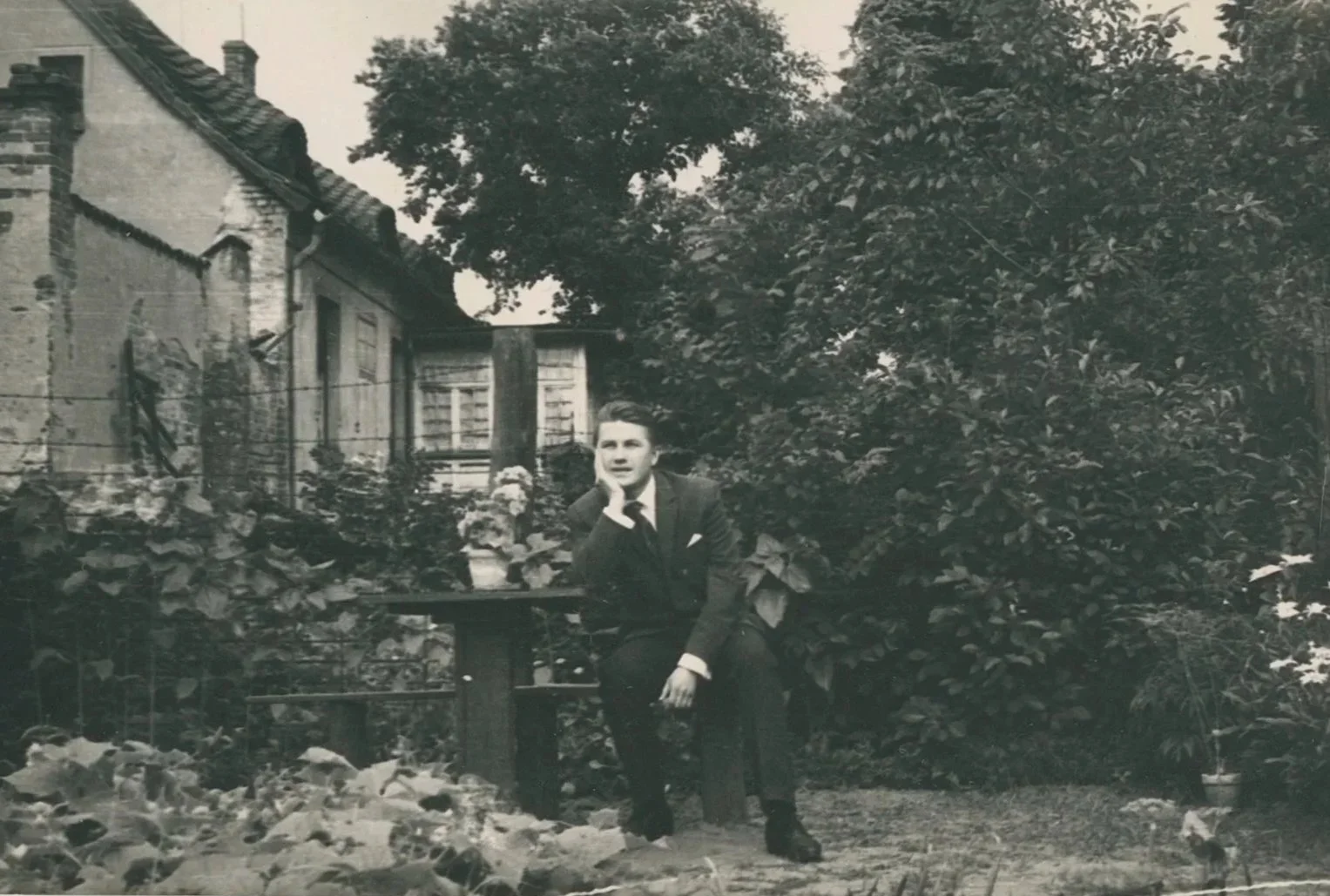
This is Grandad Bogdan
For a child, that sentence meant little more than saying someone was a teacher or a policeman. It was just a label - a profession.
It wasn’t until I went away to study architecture that my family finally began to talk - about his engineering career, and about that world I had known only by name.
And, as it turned out, one of my grandfather’s old colleagues - who had worked with him in that same Miastoprojekt - lives just around the corner from my grandmother.
And he’s an architect.
I asked for a meeting.
Not only because I wanted to learn more about my grandfather, but because architecture created under the communist regime
- in the time of the Polish People’s Republic (PRL) - belonged to a completely different creative and political reality.
July 2019.
A little bit overawed… I sit across from Mr Adam Kołodziej.
I’d asked him for a conversation I could record.
I had no plan - no list of questions. It wasn’t meant to be an interview.
It was meant to be a conversation about a reality that no longer exists
but one that, in a tangible and literal sense, shaped mine - our - spatial reality.
I wanted to hear his story.
The story of how it was.
How one created in the iron times… how one created when politics seeped into every corner of life,
when creativity itself was under strict control.
THE WEIGHT OF MEMORY
‘For a long time, I hesitated. It felt like mourning… but then I thought:
who’s going to care when I die?’
Adam Kołodziej
Together with my wife, we are at the stage of putting our life in order.
There comes a moment when a person starts to say goodbye - not in a dramatic sense, rather in a systematic sense.
Lately, I’ve been analysing different ‘eras’ : pre-computer era, when everything had to be done by hand - on tracing paper, with a Rotring pen, before that a rapidograf, and before that, with a grafion…. For you this must sound like ancient history, young people today don’t know what a grafion was.
(Mr Kołodziej was right, I didn’t know).
Those were long years…. Painstaking work, drawing projects day and night all by hand on tracing paper.
First at Miastoprojekt - where my early projects… well, unfortunately, to put it plainly, they all went to the dump.
Literally. Gone. Thrown away, into the trash.
Only the later projects survived, from after 1985, when I set up my own private design studio. At the Studio of Fine Arts, where I also worked in the same time, whole drawers were filled with those drawings, translucent sheets.
I started going through those drawers, month after month - destroying those papers and throwing them away, one by one.
Sara Kazuro
Oh, That’s really such a shame.
Adam Kołodziej
It took me a long time to let go of it all. A very long time. I hesitated. It felt like mourning. But then I thought:
‘Who’s going to care when I die?’
My son, Jacek, he won’t take all those scraps. Besides - he has a completely different outlook. Very critical of what we did.
Because he doesn’t understand the conditions we designed in - how different the reality was back then.
We worked inside a system, within restrictions, but always with a hunger to do more than seemed possible; to raise the bar as high as we could. Regulations, materials, construction methods - everything was different. Harsh. Meagre.
But we wanted to smuggle in quality.
GLOSSARY :
Grafion - an old-school drafting tool, basically a metal nib with an ink reservoir, used before technical pens were developed. Extremely precise, but messy and slow.
Rapidograph - an early refillable technical pen (by Koh-I-Noor or Staedtler), used widely in the mid-20th century for technical drawings. Produced uniform line thickness, but very prone to clogging.
Rotring - German brand of technical pens that replaced rapidographs in many studios. More reliable, became standard for architectural drawings until digital CAD systems took over.
Tracing paper (kalka techniczna) - thin, translucent paper used for copying and layering drawings. Every iteration of a plan had to be re-drawn by hand on this paper.
CHAPTER -1
Creativity in the Iron Times - Dare you say… Bauhaus?
Sara Kazuro
That’s exactly what brought me to you. On the one hand - the story of how architecture was created in those times.
On the other - how politics crept into the creative process. And then how everything flipped upside down after the system changes. Could you sketch it out for me?
Tell me the story?
Adam Kołodziej
All right. Let’s start from the beginning… with my studies.
I studied in Gdańsk, at the Faculty of Architecture.
At that time, there were only four such faculties in the whole of Poland - Kraków, Warsaw, Wrocław, and Gdańsk. Getting in was incredibly difficult: six, eight applicants for one place.
It really was the elite.
Our faculty was special. We had a lot of drawing and painting- real, serious work.
And the real sensation at the Polytechnic was this: we, the architecture students, were drawing nude models!
But it wasn’t any kind of whimsy - it was proper artistic training. Four semesters of sculpture. Busts, reliefs, abstract spatial forms. It was an approach more like an art academy.
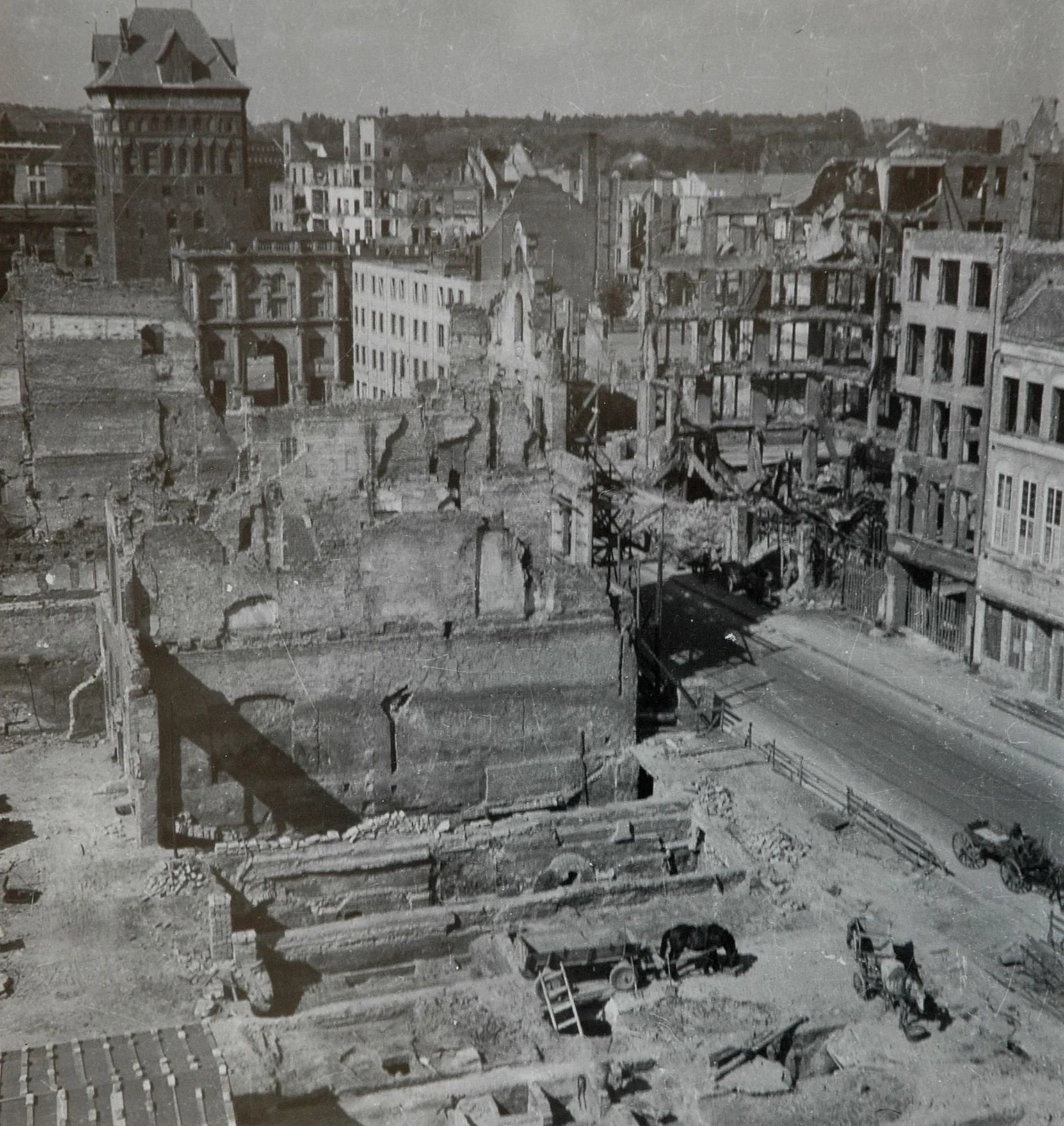
We were taught by the old masters - professors from Lwów and Wilno, educated before the war.
We were taught by the old masters - professors from Lwów and Wilno, educated before the war.
After the war, they had settled in Gdańsk and took an active role in rebuilding the city.

After the war, they had settled in Gdańsk and took an active role in rebuilding the city.
Their experience and their demands were immense.
That’s why we had brutal exams in the history of architecture. But at the same time - they placed the highest value on creation. The idea, the act of creation - that was what mattered most!
I joked: Sounds a lot like Bauhaus.
Mr. Kołodziej smiled slightly and said:
In those days no one would have dared say that out loud.
But yes - that was the spirit of Bauhaus.
Adam Kołodziej
Back then it was all about craftsmanship. Everything! At university we got used to doing every single thing by hand, on bristol board. All our drafting technique was done that way. Tracing paper was only for concepts, for corrections - you’d smudge things in pencil,
Later came a miracle - felt-tip pens, colored pencils……!
I remember the very first lettering class… where they taught us thousands of different typefaces: Gothic, Roman capitals. Endless, nightmarish exercises!
The assistant began with instructions:
- When you buy set squares, you place the triangular one against the drafting machine, draw a line, then flip it over—if it doesn’t match, throw it out!
- When you sharpen pencils - either to a point or to a chisel edge. There are pencils B1, B2, B3, H1, H2 - each for a different use.
How to draw with a match dipped in ink. How to write with the stick from a Calypso ice cream…
And exercises at home….
every,
single,
time,
damn it!
He’d give us more homework! At home we had to fill whole sketch blocks with lettering - you had to write compositions in Roman capitals, or majuscule, or some other alphabet. Good practice if you ever wanted to design tombstones….And that’s not even counting other assignments like designing a book cover… he would hand out topics at random :
- You, sir - glass.
- You, sir - wood.
I’ll never forget - my friend Jacek, the one I was close with (he’s now a professor at an architecture university in Canada), he was assigned “wood.” SO… on his book cover, he drew… a coffin.
And that’s how they released us into the world - idealists, really…
We had no idea what daily work as an architect in the PRL looked like.
Sure, we did construction practice a couple of times. We went on outdoor painting trips, measured and documented historic buildings -Toruń, for example. We sketched, measured, photographed.
But what work in design office actually looked like - nobody showed us.
After graduation, my wife and I moved to Toruń - her family was there. At that time… the demand for architects was so high you could literally “sell yourself for an apartment.” The construction consortium took us immediately.
My wife stayed home with our little daughter, who was born in our final year. Later she went back to work - she even worked on the design of Elana [the textile factory].
As for me - to get my professional license, I had to spend a year and a half on a construction site.
I was site engineer for the Helios Hotel and the Książnica.
I had absolutely no idea what I was doing….
But I was lucky - there was a Majster - the foreman who took me under his wing. He taught me everything - how to run a construction site, how it all worked “behind the scenes”. He was my first real teacher of the profession.
CHAPTER 2
Entering the Profession - The Road to Miastoprojekt
Adam Kołodziej
After working on the Helios Hotel and the Książnica library - where I really did learn a lot - the atmosphere started to sour. A handful of young people with higher education came into the Kombinat, and suddenly I was the only architect among them. The rest of the staff were seasoned building technicians. You could feel the tension right away.
It all got political. And unfortunately, I got caught in the crossfire. They moved me to smaller, less ambitious projects.
First I ended up on some dull construction site on the edge of Toruń.
One-story industrial sheds. Absolute boredom. Empty… with mice running around my office.
That was the time I began seriously trying to get into Miastoprojekt.
What helped was a chance encounter with Tadeusz, a structural engineer from Miastoprojekt - later a close friend. We ran into each other on a train from Warsaw.
He knew me as being, well, ‘a pain in the neck’ - in other words - very precise.
Once, I had caught a mistake in documentation that could have led to a construction disaster.
I basically saved the project! He said to me then:
- Well, why don’t you come work with us?
And that’s how I found myself at an interview in Miastoprojekt. I already knew them all from SARP (the Association of Polish Architects) - back then there were maybe ten, twelve architects in all of Toruń.
The director looked at me and simply said:
- Alright, why don’t you join us
So I resigned from the Rural Design Office - where I had been doing uninspiring projects for collective state farms - and I joined Miastoprojekt.
I ended up in the very same studio where your grandfather, Bogdan, worked.
And I stayed there for almost twenty years.
CHAPTER 3
The Centralisation of Creativity - Miastoprojekt, Prefabs, and the ‘Plomba’
Miastoprojekt - literally ‘City Project’- the state design bureau network in communist Poland
Plomba - an architectural term for an ‘Infill building’, filling gaps in existing urban fabric
Adam Kołodziej
The Miastoprojekts were organised all over Poland as specialised design offices. Our focus was the city - urban design and architecture.
The Miastoprojekt in Toruń was one of many bureaus across the country. Each region had its own, all subordinate to the Central Office in Warsaw, on Wierzbowa Street.
That Central Office in Warsaw handled all the prefabrication systems - OWT-67, OWT-75, WK-70.
That was what we called the ‘Great Panel’ system - the prefabricated concrete panels everything was built with back then.
They developed all the working drawings. On that basis, a ‘house factory’ was set up in Toruń, producing prefab elements based on Warsaw’s designs.
Forms, molds, production lines - everything was engineered there.
And yes, all those buildings ended up being identical, made with the same technology.
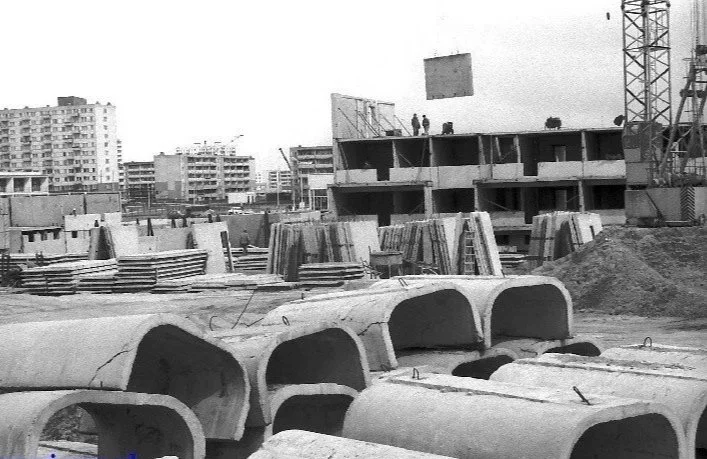
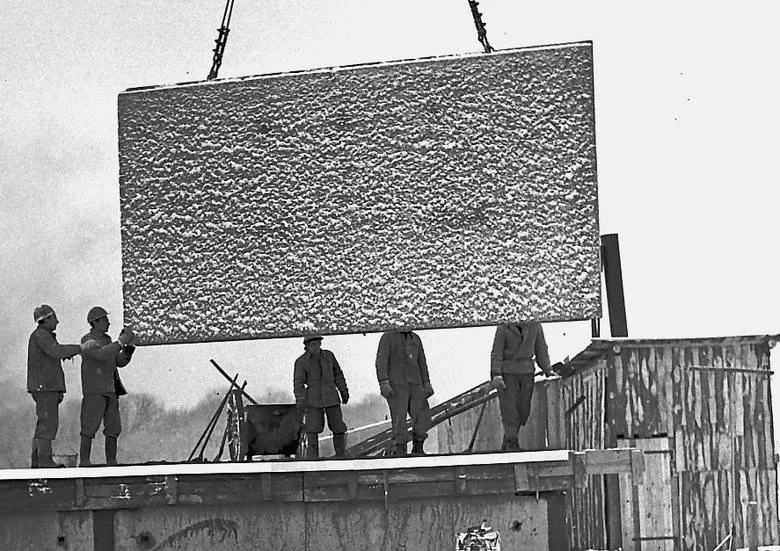
The beginning
of the block construction
in the ‘great panel system’ ( photo by Andrzej Kaminski)
Our job, as architects, was to ‘plant them’ into the urban context to ‘compose’ the neighbourhoods, adapt the catalog buildings to local conditions, and make them fit the terrain.
The - Great Panel - system (Polish: Wielka Płyta) - a standardised large-panel prefabricated concrete construction method used across socialist Poland in the 1960s–1980s. Entire housing estates were built from identical factory-made panels, reflecting both industrial efficiency and the ideological pursuit of uniformity.
Adam Kolodziej
In Miastoprojekt, the teams were mixed, both technicians and architects worked side by side-and, a huge part of the team were women. The ratio was usually something like : me as the General Designer, and six or eight women, that was my team.
Most of the building technicians were women, but we also had women architects.
And they certainly didn’t earn less than us - absolutely not!
Were they less respected?
God forbid !
They were just as important as we were.
The hierarchy in the design offices was rigid and I used to joke that it was like in the army :
Someone with a technical diploma was a technical assistant.
Then came assistant designer,
then senior assistant,
then designer,
then senior designer,
and finally chief designer.
And at the very top of the ladder was General Designer.
There were maybe fifteen, twenty of those in the whole country.
When I finally reached that title, it came with a mountain of administrative and organisational responsibility. But to stay sane I made one condition:
I am still going to design.
Around that time, in Toruń, the president of the Kopernik Housing Cooperative started a new trend. He wanted ‘plomby’. This meant new ‘infill’ buildings squeezed into empty lots between older ones, mainly in the city center.
Adam Kolodziej
Designing those was more relaxed.
That president wanted them to be showy -‘exclusive apartments’.
Everywhere else we were watched like hawks with Regulation 110 - no apartment could be bigger than 48 square meters, period. In those blocks it was strict.
But here? We could, with trembling hands, sneak in three square meters more… five square meters more.
Those apartments were intended for people the president had close ties with - the nomenklatura.
Sara Kazuro
Meaning the Party elite?
A.K
Exactly. “The Party” meant the Communist Party - the one and only political structure back then. People tied to it had privileges: better apartments, car vouchers, access to goods and opportunities that ordinary citizens could only dream of. Those were the people we designed the “luxury” infill buildings for.
S.K
So would you say that with designing plomby you had more creative freedom?
A.K
Yes, there was a bit more creative freedom… if you can even call it that.
But above all - people today have no idea what kind of reality we were forced to work in.
It was mad poverty - not just lack of money, but the kind of poverty imposed by the system itself.
And on top of that - we had no idea what was happening in the world!
We were completely cut off - no news, no trends, no sense of what architecture was becoming anywhere else.
Today, you open ArchDaily and the whole world is at your fingertips.
Back then, nothing.
The only ‘western’ magazine you could buy at the kiosk was Bau-Majster, and there was nothing exciting in it.
No one was allowed to freely travel abroad.
The first time I went, was with the Architects’ Association - to Finland. And after that trip, some of my colleagues said:
That’s it, I quit designing!
A.K.
Ahhh Finland in those times… a fantastic country. The houses there-single-family, beautiful, so natural. Even now, we still haven’t caught up to that level
But later came the reflection - if we could have imported those materials, the timber, the clinkers - we might have done something like that too.
But we simply had no access to anything!
So everything was prefabricated. Boxes. As cheap as possible.
There were only two window factories in Poland. Catalogs: O1, O2… up to O35. The same windows went into towers and into family houses.
All the schools from that era - the same windows.
Once, I insisted on making a two-meter-wide double door opening. I designed the doors myself.
And because it was for the ‘infill’, they let me…
I Found a little carpentry shop, and they built them out of whatever they had on hand!
(thinking to myself) - ah, Architectural rebellion.
Why was there “mad poverty” in the PRL, and no access to modern materials?
Because Poland was a centrally planned economy, part of the Eastern Bloc, sealed behind the Iron Curtain. Contact with the West was blocked. Hard currency was scarce, and any imports went to heavy industry or the military - not housing. Prefabrication and standardisation were the rule. Travel abroad required special permits, usually only for athletes, artists, or official delegations.Result: architects worked with the same narrow set of materials and catalog elements, learning about world trends only from a rare magazine or a tightly controlled study trip.
Adam Kołodziej
On Słowackiego Street there’s one of my plomba-buildings - one of the vestibules there is all in wood…
Every section drawn out directly for the builder - they were very detailed drawings.
Some details we drew at 1:1 scale - otherwise people would go blind trying to read them!
There were no photocopiers…
Everything went to the blueprint lab, onto light-sensitive paper, developed in ammonia - the so-called ozalid copies.
Technical descriptions were written by hand, and then the ladies in the typing hall would type them up in several copies:
one for the archive, one for the site, one for the inspector of works…
The whole machinery of it.
A.K.
We actually earned quite well. We were organised in a kind of capitalist way - there was the “output” and a bonus system.
But the bonuses had to be divided - between the various technical branches, between the members of the team.
And that’s where the fights always started…
Eventually, I came up with a mathematical system, set the proportions with the team - and that was that - Peace restored.
That’s how it all worked - in very broad strokes.
A.K.
And it was around that time, with your grandfather Bogdan, that we first started thinking maybe it was time to move out of those blocks…
That’s how our first conversations began. We even had a plot in mind, but it fell through.
We wanted to build ourselves - as a group.
It wasn’t us that failed, you see - it was the whole arrangement, the permissions, the dependencies…
So in the end it didn’t happen. And good thing, really - better that way.
Later came a commission - for these houses here. Right where we’re sitting now.
That was 1974.
The design work started, and Bogdan said:
Listen, maybe you could try your hand at these houses?
And I said: Why the hell not, all right - I’ll give it a try.
I have set up a meeting with the director of Elana.
I offered that, as a social initiative, we’d do the designs cheaper, but I wanted to reserve a place for my design team. He agreed! And… here we are.
Of course, there were some adventures along the way…
Solidarity took an interest in us :
Beneficiaries! While the working class goes unnoticed!
But the director was strong enough, politically, that nothing happened to us.
Later, during martial law, that old Party hardliner - Comrade Siwak - turned his gaze on us again.
Then came the system changes, privatisation… loan repayments…
But we managed to sail through all those reefs.
And that’s why we’re still here.
Context :
Elana – a large state-owned textile factory in Toruń, one of the city’s biggest employers at the time.
Solidarity (Solidarność) – the independent trade union movement founded in 1980, which became the leading force opposing communist rule in Poland.
Comrade Siwak – Janusz Siwak, a prominent hardliner in the Party’s Central Committee, known for his hostility toward Solidarity and “intellectual elites.”
‘ Well…(mr Kołodziej smiled) but it wasn’t only plomba-builds we were designing back then.
Actually, that’s when I got tangled up in the whole Rubinkowo story.’
Chapter 4
Rubinkowo - An Accidental Victory - The competition, the hexagons, and a project designed to be rejected -
Context
Rubinkowo – one of the largest postwar housing estates in Toruń, built 1970–1985.
SARP – Stowarzyszenie Architektów Polskich (Association of Polish Architects).
KC PZPR – Central Committee of the Polish United Workers’ Party, the ruling communist authority.
Wielka płyta – literally “big slab,” a prefabricated concrete panel system used for mass housing construction across the Eastern Bloc.
Normatyw urbanistyczny – state planning standards regulating density, building spacing, and access to services.
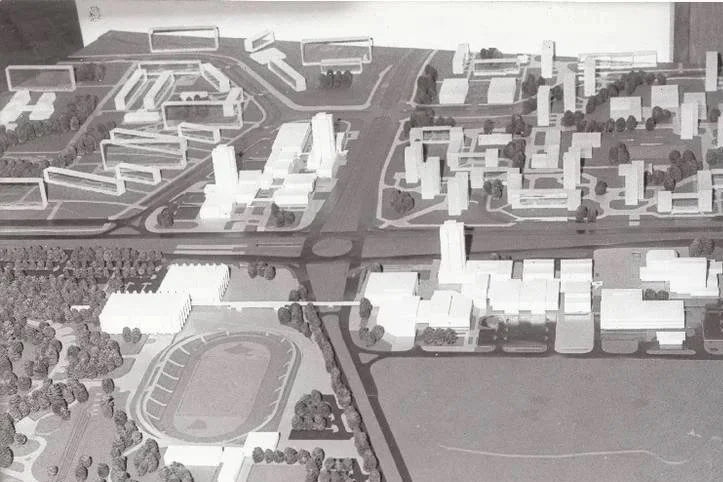
Model of Rubinkowo District
fot. Andrzej Kamiński
Adam Kołodziej
So…ah - we’re meandering a bit… Now, getting back to the urban planning of Rubinkowo.
There was an architectural competition announced by SARP ( architectural association ) a proper, full-scale one-for designing the whole stretch of Rubinkowo.
Renowned teams from all over Poland entered.
The first prize went to a team from Gdańsk - they designed Rubinkowo I.
But then… came a political decision.
Someone from the second-prize team had the right connections - a lady whose brother-in-law was in the Central Committee of the Party - and suddenly
it was decided that her team’s project was the “more appropriate” one to realise.
And so construction began…
Rubinkowo I - The Hexagons
The whole project was based on hexagons.
Those intersections - you drive into one, and to this day no one knows who has the right of way.
The idea was that everything would flow - gentle right turns, smooth curves…
Only in practice, well - the drivers still meet in the middle and no one knows who should go first! (laughs)
At the head of that design team was engineer Jerka - an architect.
An older gentleman, ‘pre-war’, even more so than us! (laughs), Very proper, very formal - always with a little bow tie under his chin.
Rubinkowo II - The ‘other’ Team
Then came time for Rubinkowo II - that part was designed by our colleagues from Bydgoszcz, from Investprojekt - a competing state design office
run by the housing cooperative. Good architects, friends of mine from university.
It was a small world, the world of architects in those days. Everyone knew everyone.
Rubinkowo III - Project to Be Rejected
And finally, it came to us, our turn.
Our design studio - me and Czesław Sobociński.
At that time, we were still knee-deep in plomba projects, those infill buildings. And suddenly - Rubinkowo III lands on our desk.
So we thought:
Well, if we’re going to do it,
we’ll do it so that they’ll never accept it.
We proposed the buildings to be stepping up in height - five, seven, nine, eleven storeys - in irregular sequence.
We laid out the buildings as stepping up in height -five, seven, nine, eleven storeys - rising in rhythm across the terrain.
The composition was irregular, a kind of urban cascade.
We thought :
perfect! - Jerka’s scheme will win, they’ll throw ours out right away, and we won’t have to deal with those prefabs.
We built the model…
Then came the big meeting - the one where the decision-makers were to choose which concept would move forward.
The top people from Toruń gathered:
the First Secretary of the Party,
the Second Secretary,
the Chairman of the City Council - all the big shots
And suddenly - they were thrilled
- Wait… you can build them like that?!
- How fresh!
- Five - seven - nine - eleven?
- Brilliant!
…And that was it. They picked our proposal!
To our great frustration.
Because we had absolutely no desire to deal with prefabrication!
But Rubinkowo III fell into our hands… To move forward, it still had to be approved by the Central Union of Housing Cooperatives in Warsaw.
Czesław managed to avoid the trip, so I went - with the directors, in the company minibus, right in the middle of a freezing winter.
We arrived, and immediately the reaction was :
- Absurd!
- Aberration!
- There’s no way something like this could ever be built.
- Forget it.
Negative review. The end.
But in Toruń it was already too late - nobody wanted to back out.
We all had the knife at our throats.They ordered us to re-design it.
So, we threw out the hexagons, instead we laid it out in quarters.
And that’s how Rubinkowo III went ahead.
We divided the estate into five structural units.
The rule - or rather, the requirement - was that every unit had to have its own schools, kindergartens, shops, all the essential services.
Looking back now, I think that was probably the best urban-planning code Poland ever had.
At the time we cursed it, of course - we said it tied our hands, norm after norm after norm.
But the system itself was excellent: the prescribed distances between buildings, the ratios of greenery, the balance of open space - really, a fantastic standard.
(And listening to Mr Kołodziej talk about it, you can’t help but notice his natural defiance - a quiet rebel in the age of regulations.)
A.K.
When we looked at the layouts of Rubinkowo I and II, we said to each other :
Jesus, look what Jerka’s done - everything packed so tight!
That layout?
Never in life!
So we designed ours loose. Spacious.
And one day a Party official came from Warsaw, from the Central Committee.
He looked around and asked, surprised :
Why is everything so… spread out here? (laughter)
Later I said to Czesław:
‘You know what, this is all so boring.
Let’s name the sectors after our wives and kids!’
And so we did…
We called them Bożena - Czesław’s wife, Regina - my wife , Karolina - my daughter, Maciej-his son and Anna - our colleague’s daughter - she worked on the landscaping.
The surveyors wrote the names on the official maps of Toruń - and that’s how they stayed. Rubinkowo III has family names.
S.K.
I remember that! I always wondered why the blocks had people’s names.
A.K.
Ha! Well, now you know. (Smiles)
We even tried to get creative with the street names…but we lost that battle to the historians from the university.
That’s how it all began…
After that, the pace was brutal - buildings, calculations, all done by hand, because we didn’t have computers back then.
Later, Bydgoszcz got one - the ORDA, a machine the size of a small house. But before that - it was all pencils and tracing paper.
We’d make little wooden model blocks at a 1:500 scale, move them around the table to plan the layout of the estate.
When Czesław moved on to other projects, I finished the rest myself - and that’s when I became the General Designer of Rubinkowo III.
And that’s how it turned out.
A project we thought would be rejected… turned into a whole neighbourhood.
Chapter 5:
To Create, no matter what
A.K.: For the first three years at Miasto-Projekt… an unbelievable number of projects went straight into the trash. Unbelievable.
We designed with enormous effort - pour everything into it - and then, bang - nothing got built.
I designed, for instance, a huge sanatorium for the confectionery industry in Ciechocinek. A massive project, full of ideas, full of heart.
And what happened? Cancelled. Just like that.
Then came a grand hotel - Orbis - with a sanatorium for the Polish diaspora abroad.
As part of the preparations, I travelled to Poznań, to the Orbis Hotel Investment Office. Everything had to be at a European level.
Even the whole thing - what we used to call ‘mechanising the kitchen’ back then - had to be imported.
There was a room waiting for me at the hotel.
I’d stay as long as I needed, talking with people from different departments - for example, with the kitchen technologist.
His desk was covered with glossy, colourful leaflets and brochures - the kind that gets stuffed into your mailbox today, but back then - it was something completely unseen.
A whole new world! Boiling kettles, slicers, peeling machines - all those contraptions.
Based on that, we’d work out the technological layout for this sophisticated kitchen. Every part of the project was developed down to the tiniest detail.
The design was ninety-five percent finished. And then suddenly - the end. No funds.
Project stopped.
They paid us ninety-five percent, sure, but so what?
I was crushed. I said to my technical director:
- Nothing left but to hang myself! Everything I design ends up in the trash. (I really was on the edge then)
And he looked at me and said:
- You must be out of your mind! Money taken?
- Taken.
- So what’s the problem? You should be happy! Got your bonus? Team’s satisfied.
No construction headaches, no coordination meetings. Perfect situation! We need more projects like that!”
But I just couldn’t be happy.
Because for me - I had to create something. Even if never got built - you still had to try.
Then came the Cepelia centre in Ciechocinek. Another commission. Investor from Gdynia. Everything was designed. They’d even gathered the steel for it.
And what happened?
The Party officials decided the steel was needed somewhere else.
Cepelia was never built.
You see, that’s when I started escaping - into what I’d call fantasy.
Because we had no contact with the outside world. Everything we built were boxes, over and over - that square, repetitive way of thinking.
So I tried, within what little freedom I had, to bring something different into the space.
To shape it differently. As best I could, I experimented.
For instance, I pushed the limits of the Normative a little bit when designing a living room with a bay window, so the light would fall in another way.
That changed the whole psychological perception of the space.
And if the sun came up here - on the south-facing side - it wouldn’t reach the room until noon.
But if you angled the window just so, the sunlight would hit already in the morning.
I even used timber cladding oaths ( like in Finland ) - beautiful!
Of course, after two years everything went to hell. The paint peeled off - there were no proper protective finishes back then.
Still, I kept on trying.
Like any architect - some projects were better, some worse.
Some I’d gladly demolish today, honestly.
But you had to keep designing.
Because if you stopped - you’d lose your mind.
A.K : The time pressure was enormous.
You got a new topic - and by the end of the quarter it had to be done.
Sometimes a week for a whole concept!
And remember - no computers. Everything by hand!
The assistants painted the colour schemes - five, six copies, done in tempera or watercolour. ‘Ant work’.
If only we’d had a chance to see what was really being built in the West - how projects were developed what kind of buildings were being made
- maybe we’d have designed differently.
But we didn’t have that chance.
We just kept going.
I designed maybe twenty, twenty-five plomba -buildings in Toruń - Mickiewicza, Krasińskiego, Bydgoska, Słowackiego…Every street had one of mine.
But of course, Czesław Sobociński was designing too.
S.K.: So you two were competing?
A.K.: (laughs) Well, yes — I suppose you could say that!
That’s how it was.
But besides that, both of us worked at the Artistic Workshop Studio - the Pracownia Sztuk Plastycznych.
See, propaganda was important then - so the artists were important.
They made all the posters, the banners, the official decorations for all the all the socialist holidays..
The Harvest festivals, the 22nd of July - the so-called National Day of the Rebirth of Poland.
(A holiday celebrating the 1944 Manifesto of the Polish Committee of National Liberation - basically the start of communist rule).
So yes - they were valued. Artists had guaranteed studios. The clever - better connected ones got theirs in the Old Town.
If you weren’t that lucky, you had to improvise.
You’d claim a small room on the top floor of an eleven-storey block and turn it into a studio.
So that’s what I did.
I applied for one and got it - a tiny room with a sink and some shelves I built myself.
They’re still in my basement today.
And there, after work, after dinner, I’d sit three or four hours.
You won’t believe it - but I drew details in 1:1 scale. Chairs, benches, everything.
Of course, there was always a commission. There was a commission for everything.
At that moment, Mr Kołodziej invited me upstairs to his studio, where he showed me the old project documents — among them, a manual of lighting standards for interior design.
Adam Kołodziej : Later I designed a building on Krasińskiego, - it was supposed to be a Golden Autumn House, a retirement home.
I designed It as a series of boxes, shuffled together. The plot of land was narrow, and I thought:
- Well, if I were retired, I wouldn’t want to spend the rest of my life facing north.
Today, that design would never pass!
I made the building in the shape of a W - so from the street side there were corridors, broken into segments to avoid that “gun barrel” effect,
and on the south side were the flats.Today, impossible - given how tight the plots are now, it wouldn’t stand a chance.
In the end, the retirement home plan fell through.
The housing cooperative director decided that young couples would move in instead.
Sara.Kazuro: In preparation for this conversation, I watched a film - in one scene, during a presentation of an architectural model, a Party official stands over it
and orders a building to be placed right in the middle of a lake.
From what you’re saying - that doesn’t sound far from the truth.
A.K.: (chuckles) Yes, that scene’s a bit exaggerated, but the reality wasn’t much different.
In that “Golden Autumn House”, I had designed wooden balcony railings with flower boxes, facing south. And they told me :
- We’re not making those railings. There’s no materials
So I asked :
- So what am I supposed to redesign the railings with?
- We only have flat bars, 30 by 3 millimetres. If you can design with those - no problem.
And so…you had no choice, you had to adapt.
That’s how it was.
Projects often ended up in the bin.
But we kept creating - because there was no other way.
Luckily…the projects we did manage to finish (the ones that were not cancelled) - they took them, and they built them.